

Scaling the Future: Why Homogenization Is Critical for Alternative Protein Succes
The science behind alternative proteins is advancing fast, but scaling from pilot to full industrial production remains the industry’s biggest hurdle. Achieving commercial viability means combining pharmaceutical-level precision with true food-industry throughput. This feature explores why high-pressure homogenization has become a critical technology enabling that transition.
Drawing on expert insight from GEA Group’s Eric Ardesch, this article explains how manufacturers are merging high-capacity dairy processing with ultra-high-pressure biotech systems to achieve both volume and effective cell rupture at pressures up to 1,500 bar.
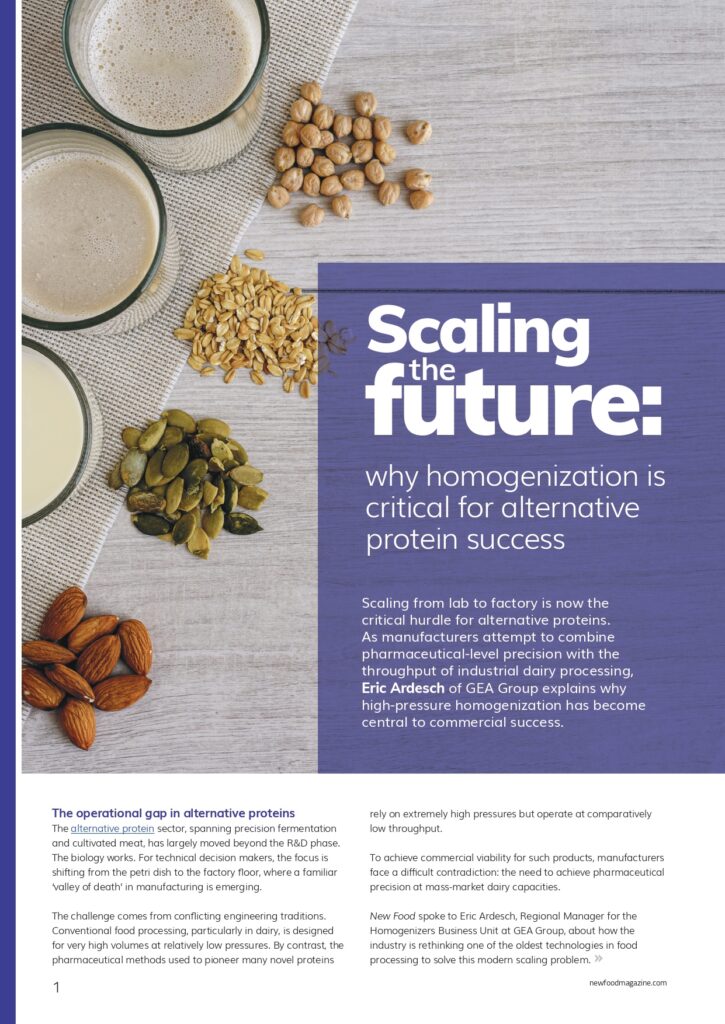
It examines where homogenisation sits within fermentation workflows, the risks of gas entrapment and cavitation at scale, and how water optimisation and smart sensors are improving sustainability, uptime and energy efficiency.
If you’re involved in precision fermentation, cultivated meat, or novel protein production, this piece offers practical insight into the engineering decisions that will determine who successfully scales.
Highlights:
- Understand the key engineering challenges in scaling alternative proteins
- Learn how high-pressure systems bridge biotech precision and food-scale capacity
- Discover solutions to cavitation, water use and operating efficiency
- Gain insight into global commercial deployment trends