
The best multi-tenant management tools for Microsoft 365
Sponsored by

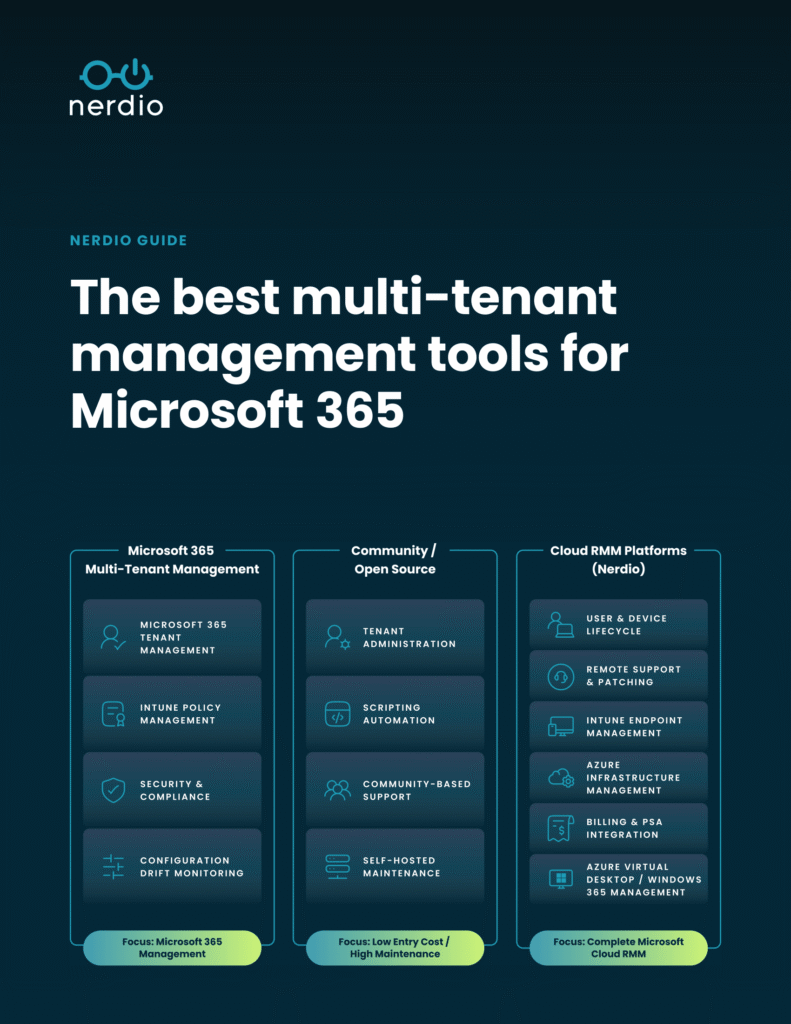
To scale a modern cloud practice, MSPs must move beyond “portal fatigue”—the inefficient cycle of manually managing individual client environments. This guide evaluates the leading multi-tenant tools for Microsoft 365, demonstrating how a centralized Cloud RMM approach eliminates configuration drift and uncouples labor effort from client growth.
By downloading this resource, you will learn:
- The Impact of Standardization: How to transition from a reactive “custom shop” to a scalable factory by managing a single “Gold Standard” baseline across your entire portfolio.
- Tooling Trade-offs: The critical differences between free community scripts and turnkey commercial platforms regarding support, maintenance, and hidden engineering costs.
- Solving Intune Operational Gaps: Strategies for resolving policy conflicts, extending data retention beyond the 30-day limit, and providing secure remote support.
- Maximizing Profitability: Proven methods for consolidating your stack and automating repetitive tasks to increase margins without adding headcount.
As Microsoft 365 becomes the operational backbone for modern business, traditional tenant-by-tenant management is no longer sustainable. This guide explores how unified, multi-tenant operations allow MSPs to overcome “portal fatigue” and scale service delivery profitably without increasing headcount.
By downloading this resource, you will learn:
- The Power of Standardization: Why consistent baselines for identity and security are foundational to moving from manual workflows to a repeatable model.
- Comprehensive Lifecycle Management: How to bridge the gap between simple policy governance and the complex reality of Intune troubleshooting and Azure cost management.
- Navigating the Tool Landscape: A deep dive into the trade-offs between open-source scripts, admin tools, and commercial cloud RMM platforms.
- Driving Operational Efficiency: Strategies to empower tier 1 technicians with centralized management while freeing senior staff for high-value strategic initiatives.

Copyright 2026 ©Promowise Terms & Conditions | Privacy Policy | California Residents – Do Not Sell My Information